Trig Form of a Complex Number
 Posted: April 1st, 2011, 10:27 pm
The absolute value of the complex number a + bi is defined as the distance between the origin (0,0) and the point (a, b)
|a + bi| =
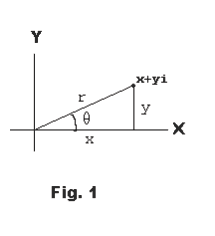
Using the complex number a + bi, we can let θ be the angle from the positive real axis (counterclockwise) to the line segment connecting the origin to the point (a, b). Therefore, a = r cosθ and b = r sinθ where r =
TRIG FORM OF A COMPLEX NUMBER
z = r(cos θ + i sin θ)
*Abbreviated form: z = rcisθ
Product and Quotient of two complex numbers
Let z[sub]1[/sub] = r[sub]1[/sub](cos θ[sub]1[/sub] + i sin θ[sub]1[/sub]) and z[sub]2[/sub] = r[sub]2[/sub](cos θ[sub]2[/sub] + i sin θ[sub]2[/sub]) be complex numbers
DeMoivre's Theorem - Powers of Complex Numbers
If z = r(cos θ + i sin θ) is a complex number and n is a positive integer, then
]^n = r^n(\cos{n\theta} + i \sin{n\theta}))
|a + bi| =
Using the complex number a + bi, we can let θ be the angle from the positive real axis (counterclockwise) to the line segment connecting the origin to the point (a, b). Therefore, a = r cosθ and b = r sinθ where r =
TRIG FORM OF A COMPLEX NUMBER
z = r(cos θ + i sin θ)
*Abbreviated form: z = rcisθ
Product and Quotient of two complex numbers
Let z[sub]1[/sub] = r[sub]1[/sub](cos θ[sub]1[/sub] + i sin θ[sub]1[/sub]) and z[sub]2[/sub] = r[sub]2[/sub](cos θ[sub]2[/sub] + i sin θ[sub]2[/sub]) be complex numbers
- z[sub]1[/sub]z[sub]2[/sub] = r[sub]1[/sub]r[sub]2[/sub][cos(θ[sub]1[/sub] + θ[sub]2[/sub]) + i sin(θ[sub]1[/sub] + θ[sub]2[/sub])]
DeMoivre's Theorem - Powers of Complex Numbers
If z = r(cos θ + i sin θ) is a complex number and n is a positive integer, then