Page 1 of 1

Electrostatics

PostPosted: February 22nd, 2012, 5:22 pm
by Jessica
Static electricity: electrical happenings that typically involve low current and high voltage

Current electricity: electrical happenings that typically involve high current and low voltage

The Law of Charges
Opposites attract, likes repel.


The Law of Conservation of Charge
The total charge in a system will always remain constant.


Net charge refers to an excess or deficiency of electrons. The electrons are the particles gained or lost when an object becomes charged - NOT the protons.

Unit of charge: Coulomb (C)


electron: -1.602 × 10⁻¹⁹ C
proton: +1.602 × 10⁻¹⁹ C
Re: Electrostatics

PostPosted: February 28th, 2012, 11:55 pm
by Jessica
Methods of Charging


1. Charging by friction - when two objects are rubbed together, it is possible for one material to be stripped of some electrons and the other to gain those electrons


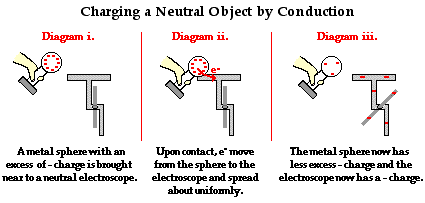
2. Charging by conduction
  • A charged object touches a neutral subject
  • The electrons will move to distribute evenly over both objects.

When the charged object is removed, the subject is left with a residual charge that is the same sign as the charge of the original object.

Image


3. "Charging" by polarization
  • A charged object is brought near (but not allowed to touch) a neutral subject.
  • The electrons will redistribute within the neutral subject according to the Law of Charges.

When the charged object is removed from the area, the electrons return to their original distribution.


4. Charging by Induction
  • A charged object is brought near but not allowed to touch a neutral subject.
  • A path is provided for electrons to enter or exit the system so as to neutralize the system.
  • The path is removed. Then the charged object is removed.

When the charged object is removed, the subject retain a charge that is opposite in sign of the originally charged object.
Image