
 by
by 
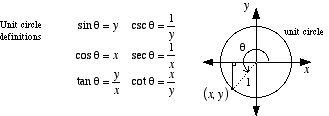
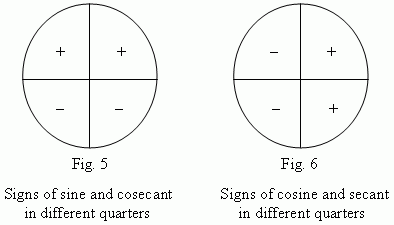
The 4 quadrants of a unit circle are just like your normal x,y coordinate planes...meaning the signs(+positive or -negative) for each (x ,y) value on a normal quadrant are the same as the signs for the (cos,sin) values on the unit circle.
In the first quadrant the x and y values, or in this case, sine and cosine values are both positive. The second quadrant has a negative cos and a positive sin. In the third one the cos and sin values are both negative. And in the last quadrant the cos value is positive and the sin value is negative.
This is how a normal 2π (360°) period breaks down.
Cosecant is the reciprocal of sine. 1/sine
Secant is the reciprocal of cosine. 1/cosine
Cotangent is the reciprocal of tangent. 1/tangent
Cosine = x so therefore cosecant would be 1/x. example: cos(2π) is 1. cosecant would be the reciprocal of that --> so csc(2π) is 1.
Sine = y so therefore secant would be 1/y. example: sin(2π) is 0. secant would be the reciprocal of that --> so secπ is undefined (0/0)
Tangent = y/x so therefore cotangent would be x/y. example: tan(π/4) is 1. cot(π/4) is 1.











 6,565.41


